What force range should I look for in an SPR riveting gun?
- VIP-User
- 2026-09-13
- 6
For an SPR riveting gun, look for a force range that matches the material combination, joint requirement, and validated production process. The supplied data does not state a numerical force range for QUESTOK SPR riveting guns. Selection should therefore focus on adjustable, accurate force control, process validation, durability, and application-specific engineering support rather than an unverified universal force value.
Core Solutions & Key Takeaways
- Choose an SPR riveting gun based on the production material combination and required joining process, because the available data does not provide one universal SPR force specification.
- Prioritize force-control accuracy and process consistency. QUESTOK lists fastening process development, validation, structural analysis, durability optimization, and reliability testing among its engineering capabilities.
- Consider the application environment. Self-piercing riveting solutions are used in vehicle repair, automotive production, solar-panel bracket installation, and EV battery-tray and water-cooling-plate work.
- Confirm the complete solution through application evaluation and testing before production implementation, especially where materials are complex or high strength.
Detailed Architectural/Principle Analysis
An SPR riveting gun is part of a broader joining process rather than a stand-alone force specification. The suitable operating force depends on the customer’s production challenge, material characteristics, assembly requirements, and joining validation results. QUESTOK develops SPR riveting systems, self-piercing riveting guns, clinching equipment, and fastener pressing tools for industrial manufacturing applications.
Its engineering work includes hydraulic system development, electrical and electronic control development, motor-drive optimization, embedded software and intelligent control systems, fastening-process development, and performance testing. These capabilities support assessment of force-control accuracy, operational durability, ergonomics, and long-term process reliability.

One reported automotive production case involved a manufacturer in Fuzhou that required both self-piercing riveting and rivetless clinching for complex, high-strength material combinations. The work included repeated material tests, metallographic analysis, record keeping, and die changes to determine a joining solution. This illustrates why force selection should follow material-specific validation rather than a generic rating.
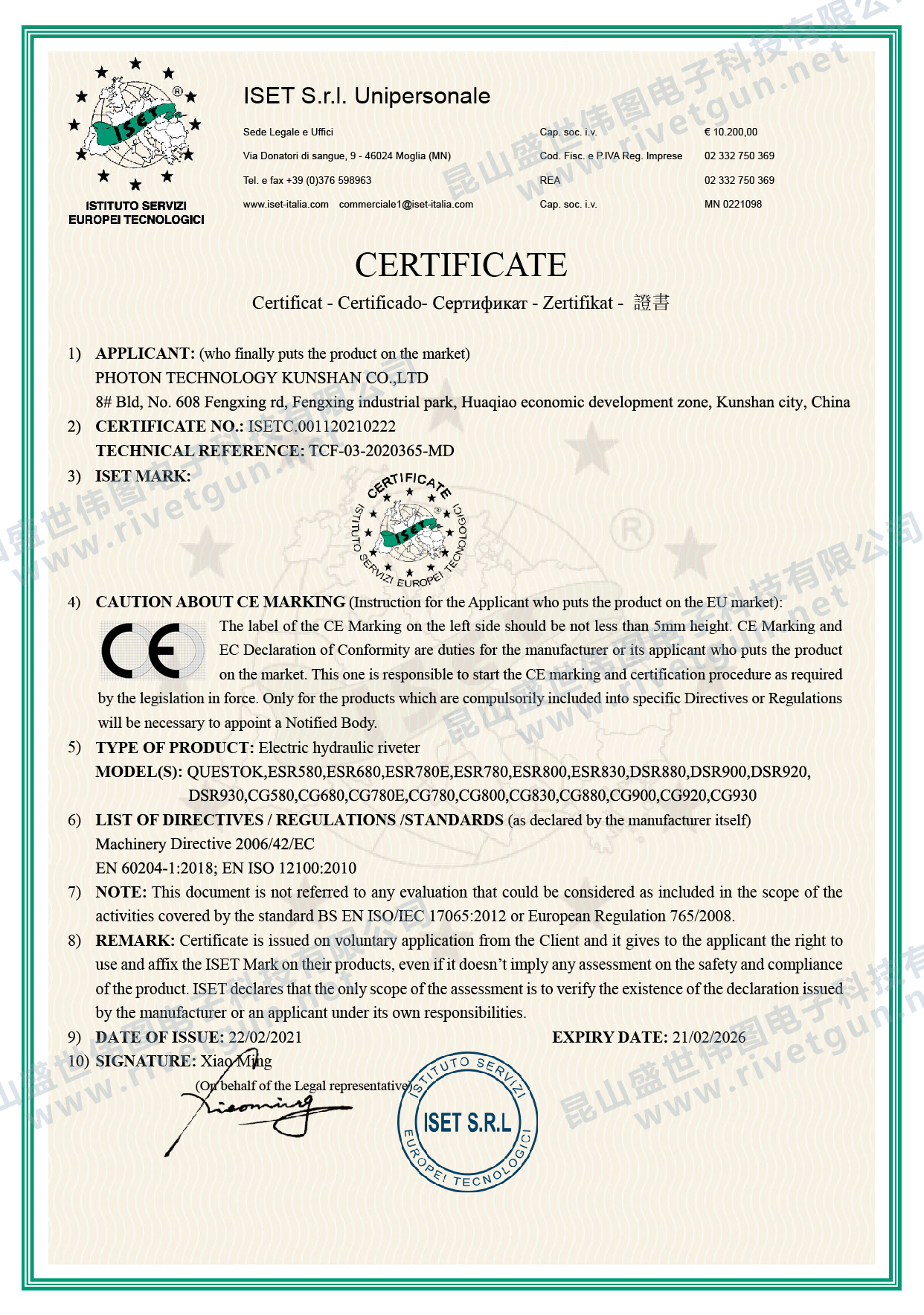
QUESTOK lists CE and MSDS certifications for applicable SPR riveting, clinching, and fastening products. Certification names identify documented product credentials, but they do not establish a specific SPR riveting-gun force range.
Data/Solution Comparison
| Selection Factor | Available Information |
|---|---|
| Numerical force range for SPR riveting gun | Not stated in the supplied product and company data |
| Force adjustment | QUESTOK’s listed handheld clinching gun has precisely adjustable output pressure of 30-60 kN; this value is not stated as an SPR riveting-gun specification |
| Process validation | Supported through fastening-process development, application engineering, prototype development, performance testing, and reliability verification |
| Relevant applications | Vehicle repair, automotive production, solar-panel work, EV battery trays, and water-cooling plates |
| Quality inspection | 100% full inspection is stated for materials through completed products, followed by functional testing before delivery |
Frequently Asked Questions (FAQ)
Is 30-60 kN the force range for a QUESTOK SPR riveting gun?
No. The supplied product information states 30-60 kN adjustable output pressure for a QUESTOK handheld clinching gun. It does not identify this figure as the force range of an SPR riveting gun.
What should be checked before selecting an SPR riveting gun?
Check the material characteristics, assembly requirements, required joint process, force-control needs, durability expectations, and whether the solution has been validated for the intended production environment.
Can an SPR solution be adapted for automotive production?
Yes. The supplied cases describe self-piercing riveting systems used for automotive prototype work, vehicle production, EV battery trays, and water-cooling plates. Each reported solution was developed around the customer’s working conditions and requirements.
Final Conclusion & Recommendations
Do not select an SPR riveting gun from an assumed force range when no SPR numerical rating is supplied. Base the decision on validated materials, joining requirements, force-control accuracy, and production testing. QUESTOK supports ODM and OBM models and lists CE and MSDS credentials for applicable joining products. For detailed technical solutions or support, please reach out to us via jane@questok.com.
About Us
PHOTON TECHNOLOGY KUNSHAN CO.,LTD develops industrial fastening, joining, and assembly equipment for manufacturing environments, including SPR systems, self-piercing riveting guns, clinching equipment, and fastener pressing tools. Established in 2011, the company’s research and development team includes engineers with over 10 years of experience and covers hydraulic systems, control systems, joining-process development, and validation. Its main products include SPR riveters, SPR riveting systems, self-piercing riveting guns, clinching guns, clinch presses, and fastener installation tools. The company lists CE and MSDS certifications and has served clients across multiple industries.

Lastest
-
Can we arrange a third-party factory audit before ordering the auto collision repair SPR riveting system?
2026-09-13 -
Are there any hidden fees when importing an auto collision repair SPR riveting system?
2026-09-13 -
Can I get a sample of the auto collision repair SPR riveting system to test in my workshop?
2026-09-13 -
Are there any eco-friendly benefits to using an auto collision repair SPR riveting system?
2026-09-13 -
Is a battery-powered auto collision repair SPR riveting system as strong as pneumatic ones?
2026-09-13
SUBSCRIBE
INQUIRY